Is “Obama Envy” Driving Trump’s Call For QE4?

We are still dazed and a bit livid over President Trump’s call for QE4, and increasingly perplexed how the market just takes such absurdities, including his latest nominees to the Fed, in stride.  Is .999 percent the next target for the Fed’s IOER?

We feel as we have been transported to a parallel universe.  Facts, words, data, logic, decency, truth, nothing matters anymore.    Just make me some more Benjies!

Our revulsion to the QE4 call motivated Global Macro Monitor’s last post,  POTUS’ Morning Economic Briefing.  Have a look.

Predictive Analytics Of Trump’s Decision Making 

We have always thought if an AI predictive analytic algorithm was constructed to analyze and forecast the Trump administration’s decision-making process it would be dominated by the policy conditional,

If the Obama administration supported, proposed or implemented such a policy,  then reverse and do the opposite.  

Iran, the TPP, and Obamacare.  Shall we go on?

There is zero doubt, in our mind, Russian and Chinese government engineers have already generated such an algo or a reasonable facsimile.

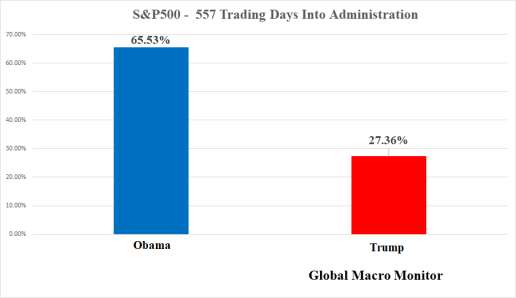
S&P500 Performance 26 Months After Inauguration

Using the above logic, the only justification we can conceive for calling for a QE4 unless Trump knows the China trade deal is toast is to further goose the stock market as Trump’s S&P is significantly lagging Obama’s market 557 trading days after the two governments came to power.  President Trump is probably aware of and likely obsessed with these relative returns.

The following chart comparing the change in both presidents S&Ps since their respective inauguration date to early April into their third year will surprise many.  We had to go back and check our calculation no less than three times.  The power of  gaslighting!

The data is especially shocking given the “the best economy ever, the greatest stock market ever” rhetoric coming from Trump and his so-called economic advisers.  That shit is getting old, folks, and really starting to wear on us.
 

Apr6_S&P500

Why The Obama Outperformance? 

Absolutely, there is logic in explaining the differential.

Such as Obama took office when the stock market and economy were collapsing and Trump inherited a bull market and strong economy,  so Trump’s market hasn’t experienced the “trampoline effect” that Obama’s S&P did.

But, truth, logic, facts, and data don’t matter anymore, folks.  Opinions and pronoucements are the new facts and data in the new  Oceania AmeriKa.

The V bottom 

Markets are now all about V bottom Fed bailouts.  Market Socialism is Capitalism.


Apr5_V_Bottowm


We expect the S&P500, driven by what we have tagged the Power of Zero, to close the year at around 3025, of which most of the rest of the year gains will take place in late Q3 and Q4.  We then expect a Big Dipper sell-off, say, at least 35 percent, for the reasons we have posted earlier, to a level of around 1984 for the S&P.

Can you connect the cryptic dots here?

Of course, our speculation is only a calculated guess as nobody knows the future.

BFTP 

BFTP = Blast From The Past

Reagan v Trump Macro Initial Conditions

Posted on 

We hear lots of talk these days about,  Why Donald Trump’s Market Rally Echoes Ronald Reagan’s.   

We are big fans of Chaos Theory,

Chaos theory is a branch of mathematics focused on the behavior of dynamical systems that are highly sensitive to initial conditions—a response popularly referred to as the butterfly effect.[1] Small differences in initial conditions (such as those due to rounding errors in numerical computation) yield widely diverging outcomes for such dynamical systems, rendering long-term prediction of their behavior impossible in general.

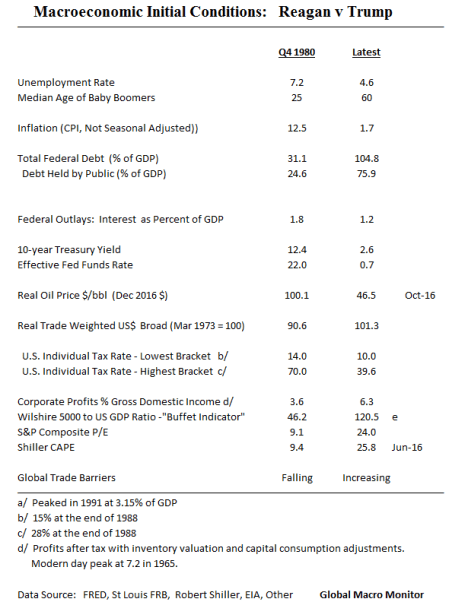
So we thought we’d take a look at the macroeconomic initial conditions at the start of the Reagan Presidency versus the incoming Trump Presidency.

Check out the data:
reagan-v-trump_initial-conditions

In most macro categories that we have researched here,  the initial conditions just aren’t there for a Reagan type bull market, in our opinion.  First, and foremost, are the monetary headwinds.

Monetary Conditions
Reagan began his Presidency with interest rates nowhere to go but south with a 22 percent Fed Funds rate and a 10-year Treasury yield of 12 1/2 percent.  Though interest rates were not the policy target of the Fed at the time,  just several months into the Reagan Presidency the 35-year bond bull market ignited and drove almost all asset prices from real estate to stocks, including the expansion of the price to earnings multiple.

The polar opposite monetary conditions exist at the advent of the Trump Presidency.  Interest rates have nowhere to go but north, we believe,  especially if Mr. Trump’s fiscal policy is implemented.

Unemployment
Mr. Trump will not have the labor slack and surplus to draw upon to drive economic growth.   The country is pretty much at full employment although the level of tautness in the labor market can be debated. This risks much higher inflation than anticipated if his policies are passed and thus a more aggressive Fed.  Also note the aging of the baby boom generation, which has driven much of the growth over the past 30 years.

Total Debt
President Reagan began his Presidency with a relatively small stock of debt.   Mr. Trump will inherit a debt-to-GDP ratio almost three times that of President Reagan.  This leaves less room for deficits as a result of his tax cuts and increased spending.   The Trump plan is to increase economic growth and thus tax revenues through supply side and micro and regulatory policy.   This is the second chance for this argument to succeed.  Watch this space.

The high debt stock, coupled with expected large deficit spending,  risks a spike in real interest rates and a sovereign credit downgrade.

Real Oil Price
President Reagan took office with a relatively high real oil price.  Note this was in an era when high oil prices were considered “bad” for the economy.   The real oil price dropped almost 75 percent in the first five years of the Reagan administration.   President Trump will inherit a real oil price half that of Mr. Reagan, coupled with the ambiguity of not knowing if higher oil prices are good or bad for the economy.  We don’t know where to go with this one.

Dollar
Mr. Trump inherits a real trade-weighted dollar a little over 10 percent stronger than President Reagan and, most likely, headed north given the world’s divergent growth and monetary policies. This could act as a headwind on corporate profits and export growth.

Individual Marginal Tax Rates
This is the pearl and central to the supply side argument.  Cutting marginal tax rates to incentivize economic behavior and growth, which will increase tax revenues that offset the revenue loss from the tax cuts.   Note,  President Reagan, cut the top rate from 70 percent to 28 percent.   That was Yuuuge!   Mr. Trump just doesn’t have the room to do such large tax cuts as he starts at a lower base with the highest tax rate at around 40 percent.

Corporate Profit Margins
President Reagan took office with a lot of corporate inefficiency and room to expand corporate profits.  It feels we are close to peak margins.   Didn’t we just have an election to improve the wages of the average worker?    Watch this space.

Stock Valuations
Much like the debt stock,  Mr. Trump will inherit a stock market that is relatively highly valued.  Note,  one of Warren Buffet’s stock market valuation metrics,  Stock Market Cap to GDP, is more than 160 percent higher now than it was when President Reagan took office.  The U.S. will need lots of economic growth to “grow” into this metric.

Conclusion
There you have it.  The macroeconomic initial conditions at the beginning of two Presidencies.   This is just our first quick whack at this analysis.

President Trump is going to have to depend on “animal spirits” to do a lot of the heavy lifting and exquisite execution of supply side, microeconomic, and regulatory reform to increase potential GDP growth.   Higher growth will increase the top line of companies and improve earnings.  But we think, after looking at the data,  the window is narrow.

Can we rally a lot?  Absolutely.  And probably will given the better business conditions initially created by regulatory reform and the fiscal stimulus.

A Reagan bull market?   We don’t think so.

By the way, and contrary to the conventional wisdom,  the Reagan bull market is only the 5th largest Presidential bull market since Teddy Roosevelt, just behind the Obama bull market.

We could be wrong and it surely hasn’t paid to short or underestimate Donald Trump.   But, he just won’t, and probably, can’t,  have the macro tailwinds that President Reagan had at his back given the initial conditions of the macro data.

Stay tuned.

 Note To Our Readers

The Global Macro Monitor website will be under construction over the next several weeks as we search and construct a “fair path” to protect our contributors from the free riders.  We have a few more posts in the pipeline but they will be few and far in between.   If you are a contributor email us and we will send out our ongoing data analysis or the research you depend on.    Cheers.     


Posted in Equities, Uncategorized | Tagged , , , | 2 Comments

POTUS’ Morning Economic Briefing

After Trump’s comments on the Fed this morning. calling for more quantitative easing this clip from Being There, one of the greatest movies ever is now more real than fiction.   The real Chauncey may soon have some solid intellectual back-up if POTUS can get his two new nominations to the Federal Reserve through the Senate.

The scene is profound as Chauncey’s millionaire friend interprets the conversation with the president as an exposition of the idiot’s economic genius.  Kind of like how Mr. Market takes the administration’s economic proclamations as solid.   God help us.

Chauncey relates to the world in every conversation with the only two things he has ever known, resorting to gardening and television buzzwords.   Similar to, you know,  free markets and capitalism.

Watch the full movie here.


Posted in Economics, Uncategorized | Tagged , | 1 Comment

QOTD: Go Josh!

QOTD:  Quote of the Day

https://twitter.com/reformedbroker/status/1113784568421736449?s=12

Posted in Bonds, Uncategorized | Tagged | Leave a comment

BFTP: The Biggest Risk At The Fed

BFTP = Blast From The Past

It’s now been more than a year since this post.   We can’t take a victory lap on such nonsense but we will say, “we told you so.”   The consequences are gonna be Fugly.  Ugghh…

Posted on

It is FOMC day, and the committee just raised the Fed Funds rate another 25 bps.

Well, actually, they increased the interest rate on excess reserves (IOER) by 25 bps to target a higher Fed Funds rate.   That is an additional $5.25 billion plus annual interest payment the Fed pays to the banks.

Strange days for monetary policy as the traditional approach to raising interest rates was to drain bank reserves through open market operations, making system liquidity tighter on the margin thus pushing up the Fed Funds rate.  Now they pay banks, add liquidity, to lock up their excess reserves at the Fed.  It is not a certainty banks will follow so the Fed augments the IOER tool with the overnight reverse repurchase agreement (ON RRP).

Orwellian, indeed.  “Tightening Is Easing.”

Policy Mistake Not Our Biggest Concern

Yes, the Fed, like all of us, can’t predict the future, often has the wrong model of the economy, and tends to miss inflection points.  Welcome to the world of forecasting.

Ben S. Bernanke does not think the national housing boom is a bubble that is about to burst, he indicated to Congress last week, just a few days before President Bush nominated him to become the next chairman of the Federal Reserve.

U.S. house prices have risen by nearly 25 percent over the past two years, noted Bernanke, currently chairman of the president’s Council of Economic Advisers, in testimony to Congress’s Joint Economic Committee. But, these increases, he said, “largely reflect strong economic fundamentals,” such as strong growth in jobs, incomes and the number of new households.  –  Washington Post,  October 27, 2005

But this doesn’t concern us as much as the Fed’s independence.

“Just let it rip”

That is we are worried more about the freedom from White House pressure and interference in conducting monetary policy than getting a few bps wrong on the Fed Funds rate.   This is especially true and relevant given the strongman tendencies and  lack of respect for institutional norms of the current president.

Here is Larry Kudlow, the president’s new chief economic adviser:

“Just let it rip, for heaven’s sake,” Kudlow said of economic growth in the U.S., during a more than hour-long interview Wednesday on CNBC. “The market’s going to take care of itself. The whole story’s going to take care of itself. The Fed’s going to do what it has to do, but I hope they don’t overdo it.”  – CNN

We concede that Kudlow may have made this statement before he was seated as N.E.C. chair.

We have not heard this kind of jawboning directed at the Fed from the White House for many years.  Even then, it was only after the president had left office.

WASHINGTON — Former President Bush said in a television interview that he blames Federal Reserve Chairman Alan Greenspan for his 1992 defeat.

“I think that if the interest rates had been lowered more dramatically that I would have been re-elected president because the [economic] recovery that we were in would have been more visible,” Mr. Bush told interviewer David Frost. “I reappointed him, and he disappointed me.”

Mr. Bush’s economic advisers, particularly Treasury Secretary Nicholas Brady, were critical of the Greenspan Fed’s reluctance to cut interest rates more rapidly during the recession of 1990-91 and the sluggish recovery that followed.  – WSJ, August 25, 1998

Political Pressures Will Build

Furthermore,  the administration is going to feel more political pressure from higher interest rates.    Let’s see how it behaves as the Fed continues to ratchet up rates and drains the lifeblood from the stock market.   The Dow Jones has no doubt become the voting machine for the Trump administration

Open Seats On The Federal Reserve

There are also three open seats on the Federal Reserve board, including the vice-chair, assuming Marvin Goodfriend is approved by the Sentate, but we do hear rumblings his confirmation may be in trouble.   Thus, five seats on the FOMC, including the NY Fed President,  are in play for some potential monetary mischief by the administration.

The question now is will Larry Kudlow use a “let it rip” litmus test in nominating future Fed governors?

If Trump wants to get reelected, he should rethink his Federal Reserve picks

If the Senate approves Goodfriend, there will be three more slots to fill on the Fed’s board of governors. Trump should avoid the usual Republican suspects and pick economists who are inclined to vote against rate increases. He can do this in the name of improving his reelection prospects. The rest of us will be happy to see workers get jobs and decent wages.  – Dean Baker,  LA Times,  March 15

Stacking The Deck

That is the larger risk.  The administration attempts to stack the deck  with “let it rip” doves.  Maybe it makes for a short-term sugar high for markets but we suspect the long-term damage of such a move will start to be discounted – an air pocket in the dollar – causing a reduction in the Fed’s credibility and doing structural damage to the U.S. economy.

We have heard nobody, absolutely no one,  bring up this as a potential risk, though concerns have been raised about how slow the administration is moving  in replacing Federal Reserve board seats and the overall inexperience of the new Fed and staff.

But the future of Fed personnel is now uncertain. Trump still has four open board governor seats he could nominate, although he has been especially slow about filling the ranks of presidential appointees. At the same time, the influential New York Fed president post is up for grabs after William Dudley announced his early resignation, and the presidency of the Richmond Fed is also open after the prior president resigned in April due to a leak scandal.  – Business Insider,  November 26

Foreign Worries

We have no doubt foreign holders of U.S. assets, especially fixed-income, are concerned, however.   Foreigners, mainly central banks,  hold over $6 trillion of U.S. Treasury securities.  It could be another reason why the dollar is so weak when it should be strengthening.

Look at today’s price action after the FOMC announcement, where growth was upgraded but not inflation risks.    Maybe they are betting robots will fill the shortage of workers in the construction industry.

Dollar_Mar20

Interesting to hear the spin today:  “It was a dovish hike.”   The conclusion of many only after watching the price action.  This is what we call “retrofitting fundamentals to the price action.”

We have some good friends that deal with foreign investment in U.S. real estate.  They constantly pound us about how their Chinese investors believe the U.S. has a big debt problem, including underfunded pensions, that is going to be monetized and inflated away.   That is why they are buying up U.S. real assets.  Interesting,  and we always keep it on the back of our radar.

When Monetary Hawks Convert To Full Blown Doves

An overly dovish Fed seems to contradict everything that the traditional “hard money” Republican Party,  including “King Dollar” Larry Kudlow and  Under Secretary of the Treasury for International Affairs, David Malpass,  has stood for.

We believe political expediency will trump ideology in this administration, however.

If stocks do enter bear market territory, watch the decibel level  When [the] Doves Cry in the administration.  Will they lean hard on the Fed to ease up?

Then watch how the dollar behaves.  That will provide a signal of Fed credibility and a road map to the future.

Confidence is a very fragile thing as the greatest quarterback in NFL history often says.  The Fed has had the credibility and confidence of markets for almost three decades now, warranted, or not.   Can it endure this administration?

Stay tuned.


Posted in Fed, Monetary Policy, Uncategorized | Tagged , , , | 1 Comment

COTD: Absurdly Correlated Markets

COTD = Chart of the Day

W-T-F?

We get that if Trump closes the southern border, the U.S only has three weeks supply of guacamole but…come on, man!   As they say, “correlation is not causation” or is it?

Do avocados settle in bitcoin?  Or is bitcoin now backed by avocados?

Must be those frickin’ ‘bots.

Posted in Uncategorized | Tagged | 1 Comment

Les misérables économies

https://twitter.com/jesuscasique1/status/1112874597576294402?s=12


Posted in Uncategorized | Leave a comment

Second Brexit Referendum On The Horizon

The British Parliament is inching ever so closer to a “People’s Vote,” a second referendum on the UK leaving the European Union.   We have never wavered and were way out in front of this issue,

BREXIT ain’ gonna happen.  The political extremes on both ends have “woke” the sleepy and complacent middle, women, and the young.

…A second vote on BREXIT is an uphill battle, but if the Trump administration gets “bitch slapped” in the November midterms the momentum and pressure for a new BREXIT vote will build, in our opinion.  — GMM, October 20th

Today’s Independent dishes on the prospects of a  “People’s Vote,”

MPs have begun a fresh push to agree an alternative Brexit plan that would be put to a referendum in the autumn, despite throwing out all options last night.

Talks will begin to settle on a “composite motion”, combining soft Brexit proposals with a commitment to putting them to the people to confirm – with the alternative of staying in the EU.

Anna Soubry, who defected to The Independent Group from the Conservatives, insisted a compromise was still achievable and that supporters of a Final Say referendum were making “huge progress”.

“I believe we can now reach, in parliament, a majority based on progress we made last night for such a compromise, composite motion. That’s what we’ll be working on this morning,” she said.

Ms Soubry pointed out that the number of Tories backing a referendum was rising – from 7 to 15 on Monday night – and that, with 280 votes, a confirmatory ballot was the most popular option.  – Independent, April 2nd

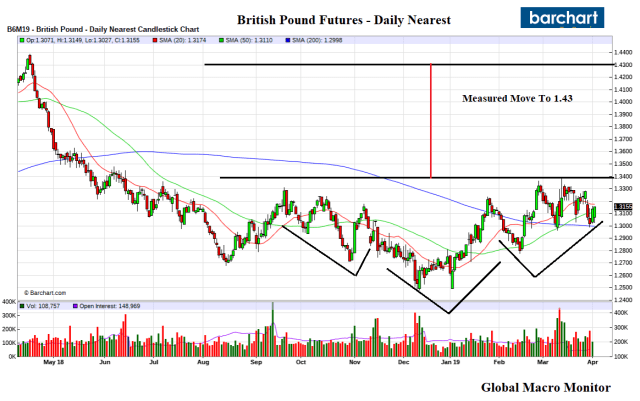
Not a trade without some risk but,

Apr2_BlueHorseShoe


Apr2_Cable_Chart

As always, we reserve the right to be long and wrong.

Posted in Brexit, Uncategorized | Tagged , , | Leave a comment

Is this the future of health? | The Economist

Artificial intelligence is already shaping the world, from driverless cars to dating. But according to Dr Eric Topol, a pioneer in digital medicine, perhaps its greatest impact will be on people’s health.

Click here to subscribe to The Economist on YouTube: https://econ.st/2xvTKdy

Posted in Automation, Technology, Uncategorized | Tagged , , | Leave a comment

The Power & Paranoia Of Redaction

Grab your popcorn and strap yourself in, folks,  for the coming political donnybrook over the full release of an unredacted version of the Mueller Report.   Me thinks it will be kicked up to the Supremes to decide.

Apr1_PowerOfRedaction

The above is exactly why we vote for full transparency with the exception of possibly some minor, but necessary, redactions to protect Agent Smith.


Posted in Uncategorized | Tagged , | 3 Comments

Beware Of Retrofitting Fundamentals To Price Action

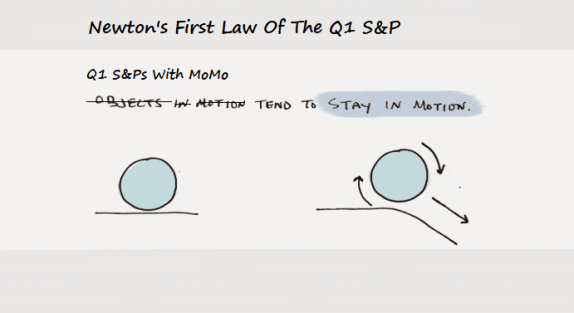
See our post, Newton’s Q1 Law Of Motion For The S&P,  by clicking here

S&P_Newton


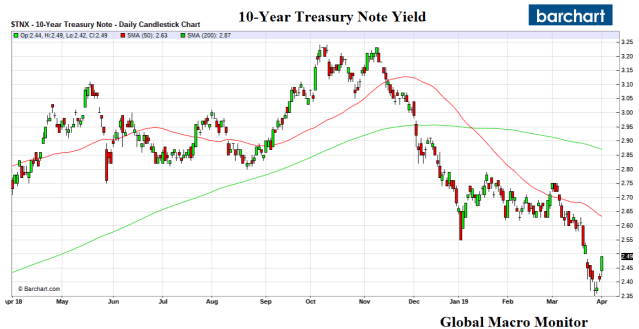
The past few weeks were a classic exercise in how markets tend to “retrofit” price action to their expectations of economic fundamentals and illustrates the risk of a self-fulfilling feedback loop.  The 10-year bond yield fell more than 40 basis points from March 1 to March 27 and the 10-year less 3-month yield curve temporarily inverted, leading even the President’s top economic advisor and his nominee to the Federal Reserve to call for an emergency 50 bps interest rate cut by nation’s central bank.

Apr1_10_year_Chart


Day trading the market and economic noise to set longer-term economic policy can be dangerous thang.  That’s Chauncey Gardener-esque, folks, and puts the credibility of U.S. policymaking into question.

Why Did Rates Collapse In March? 

Nobody really knows for certain but we suspect it was the collapse in the 10-year German bund yield, which crossed over into negative territory once again, falling from 18 bps on March 1 to -8 bps on March 27th.  The German manufacturing sector is now in a “deep recession” and the shortage of German bunds due to ECB asset purchases has distorted the economic signal of interest rates.

Apr1_German_BundInterest rates in the U.S. are affected and somewhat anchored by the German bund yield.
Nevertheless, we were a bit perplexed by the sharp move down in U.S. yields as we didn’t see the U.S. economy collapsing.  Au contraire,

Note the Atlanta’s Fed GDP now forecast for Q1 2019 has moved up from around 0.5 percent at the beginning of the month to around 1.2 percent, which is a big move lost on the markets.  – GMM, March 22

Markets are way over their skis on the deflation and growth scare.

The Atlanta Fed’s GDP Now Q1 forecast has skyrocketed over the past few weeks, up from 0.3 percent to 1.7 percent.   There is no deflation and it’s entirely possible the Cleveland Fed Median CPI prints 3 percent y/y in March with energy prices now skyrocketing.   The daytraders in and out of the administration calling for a 50 bps rate cut are panicked and clueless unless they see something nobody else does.   Could they be signaling the China trade deal is in trouble?  Just askin’. – GMM, March 31


Apr1_GDP_Now

The GDP now Q1 forecast is currently at 2.1 percent.

Moreover, the talk of deflation is just nonsense.

…the Fed began sucking dollars out of the economy. This combination of a reduced supply and heightened demand for dollars produced an entirely unnecessary deflation. – Stephen Moore,  Wall Street Journal, March 13th

Actually, that sucking sound is not the Fed reducing bank reserves but it’s the U.S. Treasury increasing the size of its monthly note and bond auctions in order to maintain its balances (checking account) at the Fed as the central bank shrinks its balance sheet.  That is coming to end in September, however.

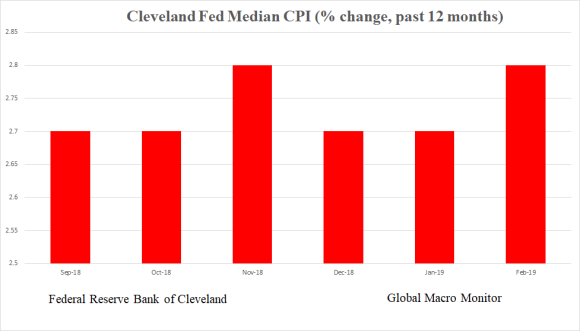
Take a look at the Cleveland Fed’s Median CPI running at an annual rate of 2.7 percent, which may approach or breach 3 percent for March with the rise in energy prices.

Median_CPI

What Now? 

If you have been reading GMM,  you know our thoughts on equities.  The sheer momentum of such a strong first quarter carries over into the rest of the year, which is the justification of our year-end S&P target of 3025.

There has not been one year since 1950, not one, where the S&P has increased by more than 10 percent in Q1, after experiencing a negative prior year, which didn’t close the year up less than 20 percent.  It’s Newton’s Q1 Law of S&P Momentum.   Is this time different?

We don’t think the move will be sustainable, however, and are selling the strength in the final three quarters, which we suspect the bulk of the final move will take place in Q4.

Bonds

Bond yields are more interesting.

Clearly for yields to take off and move much higher,   Euro yields will need to get off the mat.  The German manufacturing sector may emerge and show some improvement if China has truly bottomed.  We also expect pressure to build on German policymakers to introduce a significant fiscal stimulus.

We are now watching the key levels of 2.57, 2.63 (50-day), and 2.70 percent as the next hurdles for the 10-year to heal thyself.  Stay tuned.


Apr1_10_year_Key Levels


Apr1_10_year_Chart2


Posted in Bonds, Charts, Uncategorized | Tagged , | 2 Comments